

The research team has made progress in the study of photon Anderson phase transition Phys. Rev. Lett. 134, 053601 (2025).
Original link: Observation of Photonic Mobility Edge Phases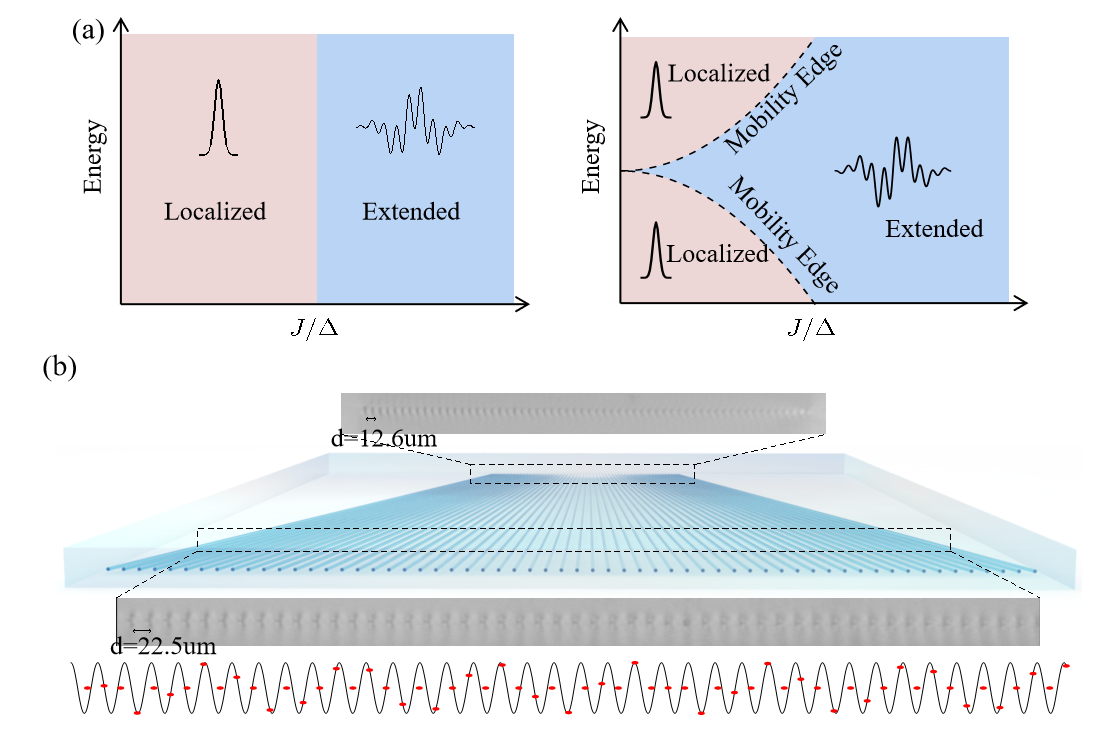
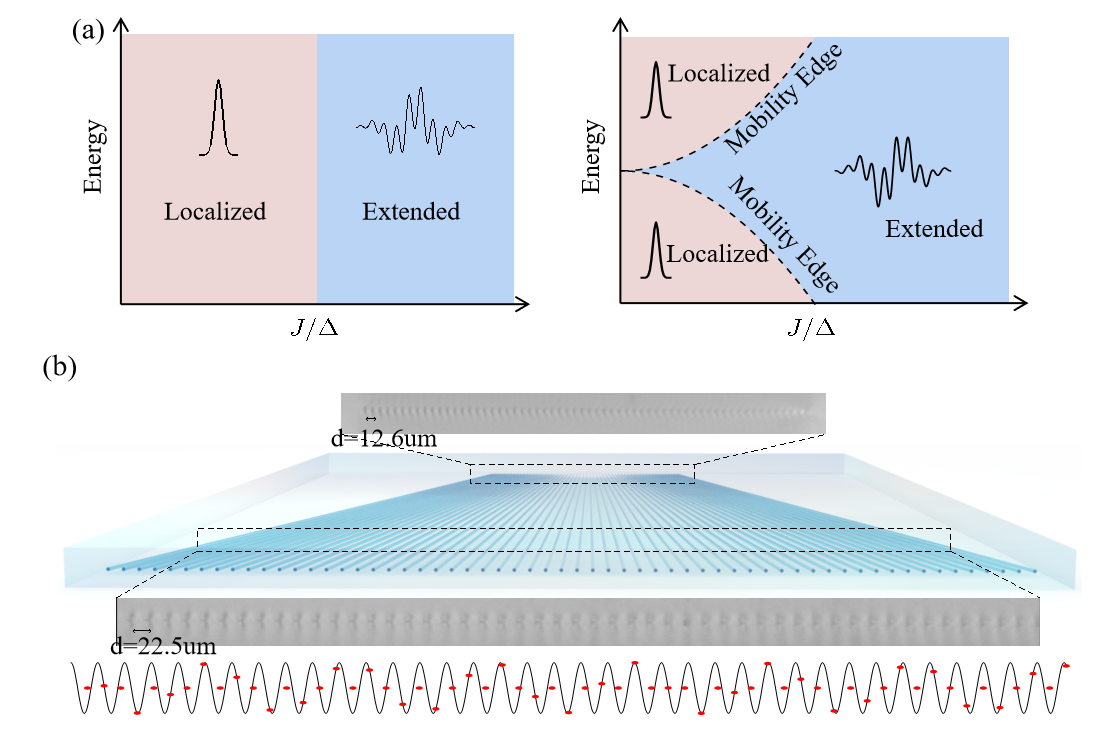
Fig.1|(a) Schematic diagram illustrating inverse Anderson localizations in quasiperiodic disordered systems. Left: energy-independent Anderson localization transition. Right: mobility edge phases, featuring energy-dependent localization transition. (b) Top: a femtosecond-laser written 89-site quasiperiodic photonic waveguide lattice. Along the photon propagation direction, the lattice spacing is fabricated to start with and end at , enabling adiabatical preparation of eigenmodes. Bottom: quasiperiodic on-site energies (red filled circles).
The research team has broken through the research paradigm of photon Anderson localized phase transition in the traditional disorder dimension (as shown on the left side of Figure a, which is characterized by the synchronous occurrence of localized extended state phase transition in all eigenstates when the disorder intensity of the system is below the critical value), and for the first time achieved photon Anderson phase transition in the energy dimension in an optical waveguide lattice. The research results include: as the disorder intensity decreases, it was found that the eigenstates in the intermediate eigenenergy range undergo localized extended state phase transitions first, while the eigenstates in the low-energy and high-energy regions still remain localized (as shown on the right side of Figure a); The intrinsic energy critical point of localized extension phase transition was directly measured, and it was observed that photon Anderson localization exhibits very different non-equilibrium quantum dynamic behaviors.