

The research team has made progress in the study of time-dislocation topological modes Nat Commun 16, 2050 (2025)
Recently, the research team led by Professor Jia Suotang and Professor Mei Feng from the Institute of Laser Spectroscopy has made significant progress in the study of topological states. The related research findings, Observation of higher-order time-dislocation topological modes were published on February 28th in Nature Communications. PhD student Zhang Jiahui is the first author of the paper, and Professor Mei Feng and Professor Ching Hua Lee from the National University of Singapore are co corresponding authors. PhD student Li Yi participated in the study, and Professor Jia Suotang, Professor Xiao Liantuan, and Professor Ma Jie provided important guidance.
Topological states are a new type of quantum state related to topology, which have natural topological protection robustness against internal fluctuations and external disturbances in the system. They have significant application value in the fields of materials science, quantum information, and quantum precision measurement. Topological boundary states are one of the most important characteristics of topological states, typically occurring at the boundaries, defects, or interfaces of topologically non trivial systems. In recent years, the topological dislocation patterns induced by the interaction between spatial dislocation defects and momentum spatial topology have attracted widespread attention internationally.
At the same time, in the field of materials science, a highly forward-looking research direction has emerged in recent years - time-dependent metamaterials. This type of material exhibits time dependence or time interface inside, displaying novel physical properties beyond traditional spatially varying metamaterials, such as time crystals, time metasurfaces, and electromagnetic wave reflection and refraction effects on time interfaces. Inspired by this, we propose a key scientific question: Is there a novel topological physics phenomenon induced by time dislocations in the time-space dimension? Especially, can the existence of topological boundary states be supported on the time interface?
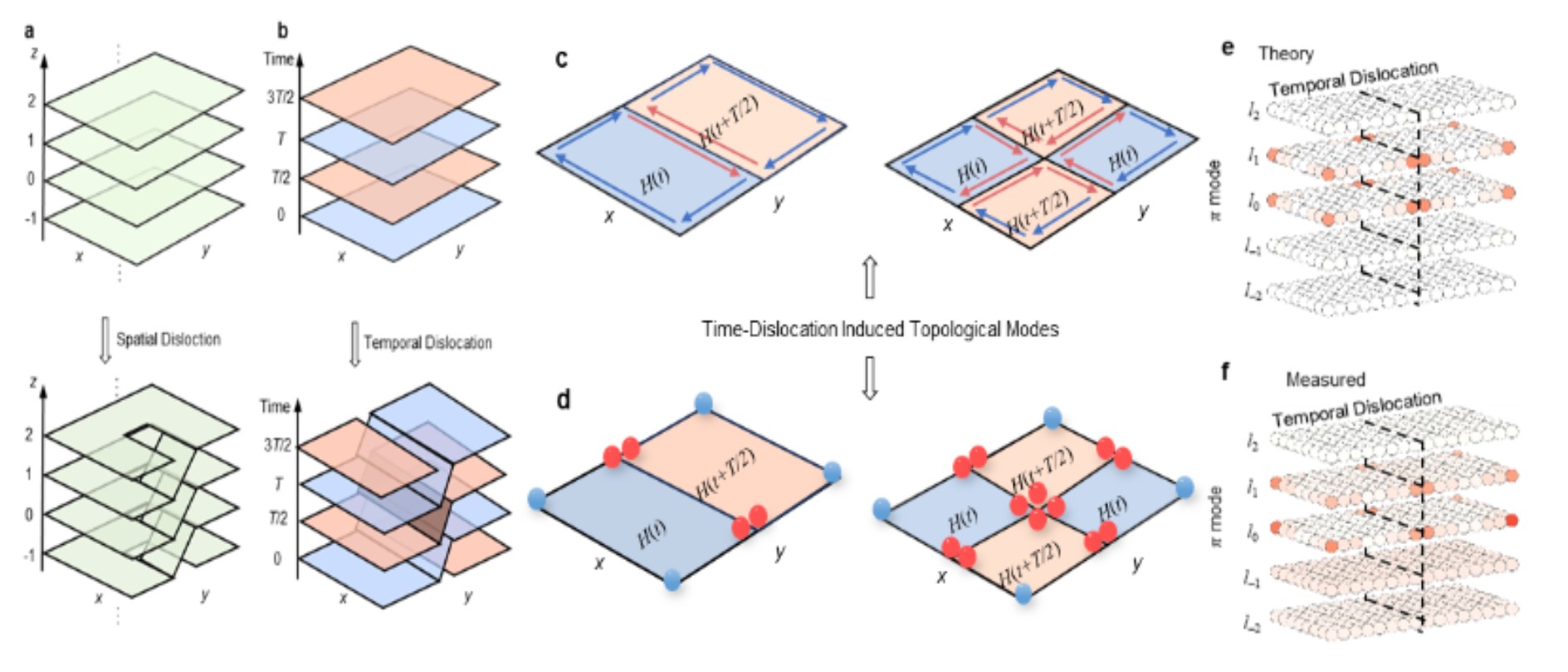
Fig.1|a A spatial lattice dislocation such as the screw dislocation breaks translation symmetry in the z-spatial direction. b A temporal dislocation can be generated by introducing time shifts or disruptions in a periodically driven system, and breaks time translation invariance. Temporal dislocations can give rise to Floquet topological c edge and d corner modes within the first- and second-order topological phases, respectively, even though the system remains spatially translation invariant. The red and blue balls (skinny arrows) represent the TCMs (TEMs) induced by the temporal dislocations and spatial boundaries, respectively.
The research team successfully constructed a temporal dislocation topological lattice by introducing time shifts in different spatial regions in a periodically driven time-dependent system. Research has found that time dislocations can induce boundary and corner states with topological protection properties; Although the coupling of the entire lattice presents a uniform distribution in space, localized topological boundary states appear at the time interface within the system. Developed topological invariants for characterizing temporal dislocation topological states and proved the topological protection properties of temporal dislocation topological boundary states. Time dislocation topological circuit metamaterials were experimentally prepared, and Pi energy Frocke topological angular states caused by time dislocations were observed. This study expands the research scope of topological boundary states from the traditional spatial dimension to the temporal dimension, providing a new degree of freedom for exploring novel topological states and their quantum control.
This research is supported by the Key R&D Program of the Ministry of Science and Technology, the Key Project of the National Natural Science Foundation, the Key Discipline Construction Fund of Shanxi Province's "1331" Project, the Outstanding Youth Fund Project of Shanxi Province, the National Key Laboratory of Photon Technology and Devices, and the Extreme Optics Collaborative Innovation Center jointly built by the province and the ministry.