

The research team has made groundbreaking progress in the quantum simulation of non-equilibrium topological states Science 390, 930 (2025)
Recently, Professor Sutang Jia and Professor Feng Mei from the Institute of Laser Spectroscopy, Shanxi University, along with Professors Jianwei Pan, Chengzhi Peng, Xiaobo Zhu, and Ming Gong from the University of Science and Technology of China, achieved and detected high-order nonequilibrium topological phases for the first time internationally. The related paper, titled Programmable Higher-Order Nonequilibrium Topological Phases on a Superconducting Quantum Processor was published in the international top-tier academic journal Science on November 28. Haoran Qian and Ming Gong from the University of Science and Technology of China, along with Jiahui Zhang from Shanxi University and Shaojun Guo from the University of Science and Technology of China, are the co-first authors of the paper. Professors Feng Mei from Shanxi University, Xiaobo Zhu and Jianwei Pan from the University of Science and Technology of China serve as the corresponding authors. Key collaborators include Professor Sutang Jia from Shanxi University, Professor Chaoyang Lu from the University of Science and Technology of China, and other contributors from the University of Science and Technology of China.
Topological phases of matter transcend the traditional classification framework centered on symmetry breaking, revealing a new paradigm where phases can be defined by their global topological invariants, which was awarded the 2016 Nobel Prize in Physics. Higher-order topological phases, as a significant recent advancement in this field, fundamentally deepen the bulk-boundary correspondence principle by demonstrating that topologically protected phenomena can exist in lower-dimensional nested boundaries, such as zero-dimensional topological corner modes. These topologically protected zero-energy modes possess non-Abelian statistics, providing a novel physical platform for topologically protected quantum information processing. However, achieving and detecting higher-order topological phases in quantum bit systems remains a cutting-edge scientific challenge on the global stage
.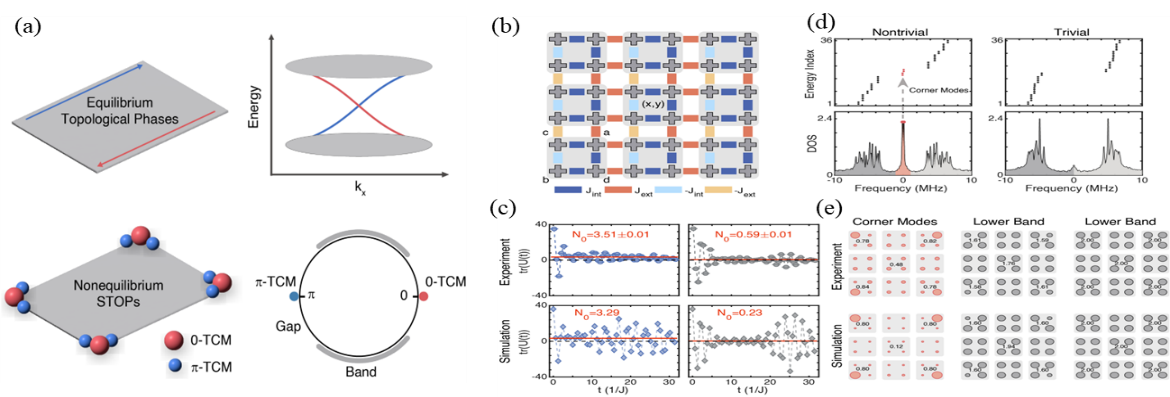
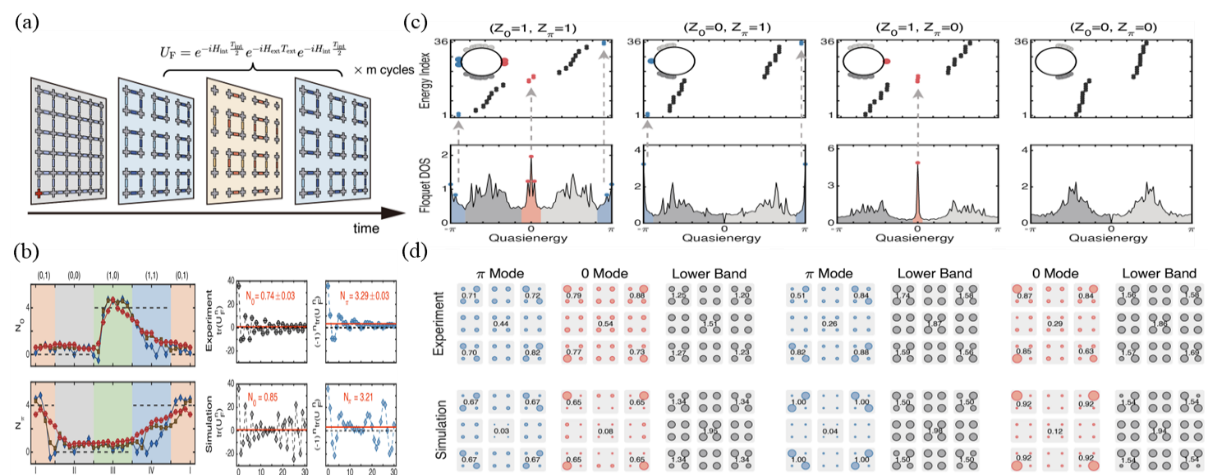
Fig. 2 a: Non equilibrium high-order topological state quantum programming circuit. b: Unbalanced higher-order topological invariants. c: Non-equilibrium high-order topological energy spectrum, d: non-equilibrium high-order topological local density of states detection.
At the same time, with the continuous development of quantum control technology, the research on state control has undergone a profound transformation from the equilibrium paradigm to the non-equilibrium paradigm in recent years, and the research scope has exceeded the theoretical framework of traditional equilibrium statistical mechanics and condensed matter physics. Unlike equilibrium topological states defined by the properties of equilibrium wave functions, non-equilibrium topological states are formed through non-equilibrium processes such as external forces, periodic drives, or quantum quenching, which push the system away from equilibrium and induce novel dynamic orders and robust phenomena that do not exist in equilibrium states, such as topological pumping, topological time crystals, dynamic topological phase transitions, π- energy topological boundary modes, topological thermalization, etc. This opens up new avenues for high-precision and robust quantum control of quantum states using topological protection in the time dimension. However, such states cannot be fully described by traditional equilibrium topological state classification frameworks, and are difficult to prepare and observe using conventional equilibrium regulation and detection methods. It is urgent to develop preparation schemes, characterization theories, and detection methods for non-equilibrium topological states.
The research team has achieved high-order balanced and non-equilibrium topological states for the first time based on the programmable Zuchong No.2 superconducting quantum processor. The research team designed a superconducting bit array model and quantum programming circuit to achieve balanced and non-equilibrium high-order topological states, developed chiral quantum dynamics theory to characterize and detect balanced and non-equilibrium high-order topologies, and solved the problem of constructing, characterizing, and detecting high-order non-equilibrium topological states in programmable quantum information processors; A systematic optimization scheme for quantum processors has been established, and dynamic control of quantum bit frequency and coupling strength has been achieved through precise calibration. Quantum evolution operations with up to 50 Floquet cycles have been successfully performed on a 6 × 6 quantum bit array, and four balanced and non-equilibrium high-order topological states have been successfully achieved. The topologically protected balanced and non-equilibrium quantum bit angular modes have been observed for the first time. The system has explored non-equilibrium topological characteristics, including non-equilibrium topological quasi spectra, non-equilibrium topological quantum dynamics, non-equilibrium topological invariants, and non-equilibrium topological local state density.
This work marks an important breakthrough in quantum simulation for exploring high-order topologies and non-equilibrium states, laying a key foundation for the next step of utilizing programmable quantum information processors in non-equilibrium strongly correlated topological states and achieving quantum advantages in quantum simulation.
This research has received strong support from the National Key R&D Program, the National Natural Science Foundation of China, the National Key Laboratory of Photon Technology and Devices at Shanxi University, the Extreme Optics Collaborative Innovation Center, the Shanxi Province "1331 Project" Key Discipline Construction, and the Shanxi Province Basic Research Program.